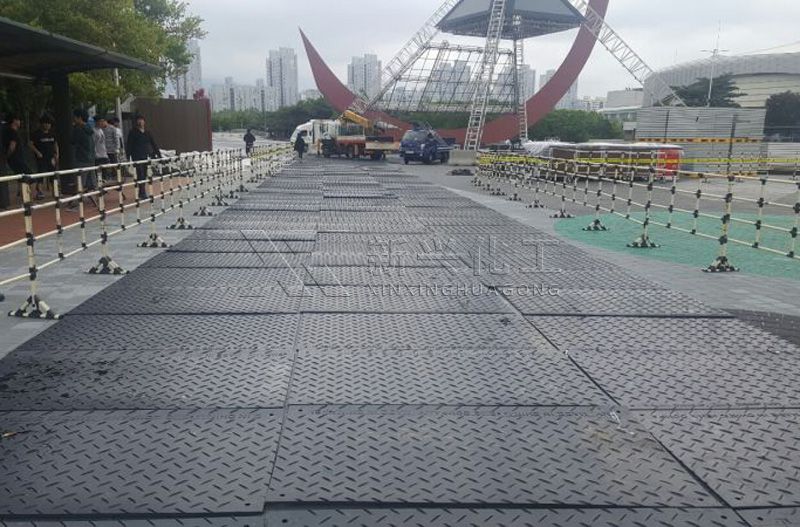
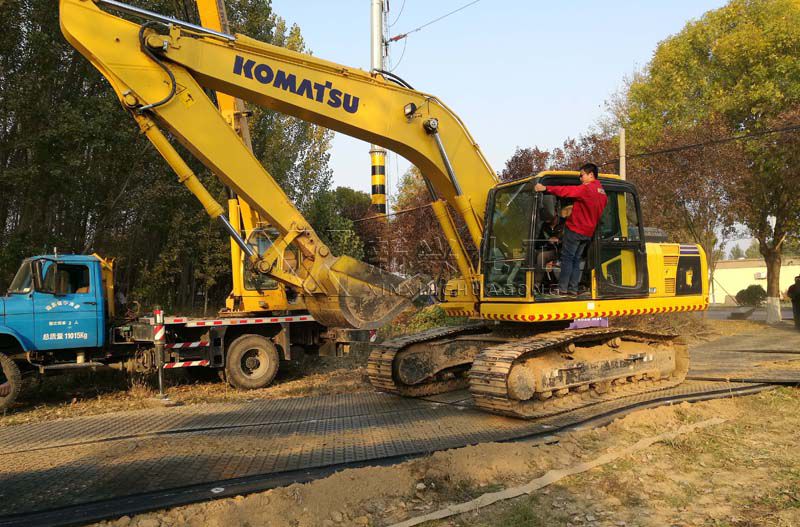
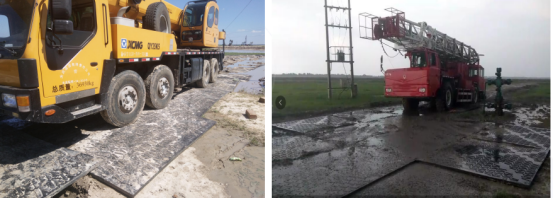
XINXING oilfield access mats were used to establish temporary access roads for heavy vehicles operating in muddy swampland at an oilfield project in Songyuan, China.
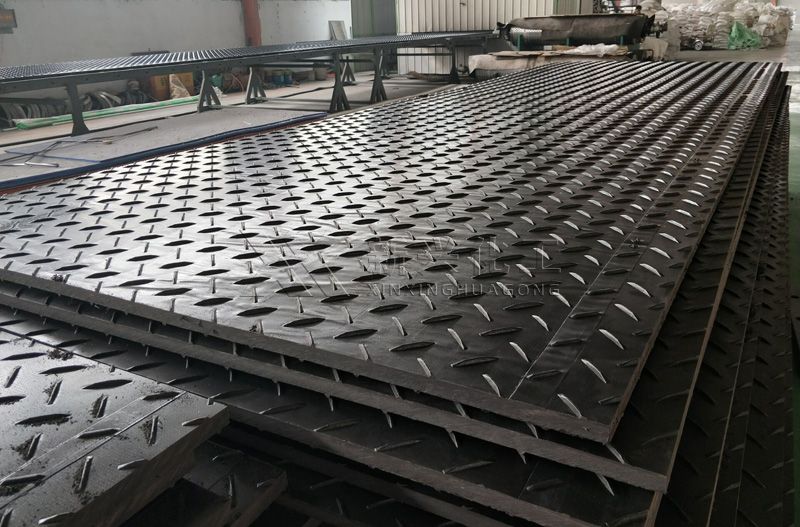
The project required temporary access for heavy trucks, drilling equipment and machinery transport vehicles operating in the 60–80-ton range. XINXING supplied heavy-duty Dura Mats measuring 3000 × 2500 × 37 mm to create connected access surfaces over challenging waterlogged ground.
This project illustrates how properly selected temporary road mats can help oil and gas contractors maintain equipment access where conventional unprotected ground routes are difficult to use.
| Project Details | Specifications |
|---|---|
| Project location | Songyuan, China |
| Industry | Oil and gas |
| Application | Temporary oilfield access roads |
| Ground conditions | Muddy, waterlogged swampland |
| Project vehicle requirements | 60–80 tons |
| Matting solution | XINXING Dura Mats |
| Panel dimensions | 3000 × 2500 × 37 mm |
| Panel configuration | Connected heavy-duty road mats |
| Primary purpose | Maintain access and reduce vehicle immobilisation on soft ground |
The original project documentation identifies difficult swampland conditions as the main access challenge.
Heavy vehicles and oilfield equipment needed to travel across areas where wet soil, unstable ground and rainfall made unprotected access unreliable.
Oil and gas infrastructure projects often take place in remote locations where permanent access roads are unavailable or impractical during construction.
Equipment transportation becomes particularly difficult when sites contain saturated soil, muddy tracks or low-bearing-capacity ground.
Loaded transport trucks, drilling equipment and support machinery place significant pressure on the ground.
When the underlying soil cannot adequately support these loads, vehicles may sink into the surface or develop deep wheel ruts.
Recovering immobilised machinery can disrupt construction schedules and require additional equipment.
Even when a vehicle successfully crosses soft ground, repeated movements may progressively worsen rutting and soil displacement.
A route that is initially usable can become increasingly difficult after rainfall and repeated heavy traffic.
Oilfield activities depend on reliable delivery routes for equipment, construction materials, personnel and maintenance support.
When access becomes unreliable, contractors may face delays in equipment mobilisation, servicing and site preparation.
Wetlands and swampland may have sensitive drainage and soil conditions.
Temporary road construction should consider environmental requirements, drainage patterns and the potential disturbance caused by imported materials or vehicle traffic.
To address these challenges, XINXING supplied a connected Dura Mats system for the Songyuan oilfield project.
The project documentation identifies the selected panels as UHMWPE ground protection mats with a 3000 × 2500 × 37 mm configuration.
These panels were used to form temporary access surfaces for project vehicles and equipment.
XINXING Dura Mats are designed for demanding industrial access applications.
Their engineered polyethylene construction provides abrasion and impact resistance, along with moisture resistance suitable for outdoor working environments.
Unlike timber-based mats, polyethylene panels do not rot or splinter from prolonged exposure to wet conditions.
Large road panels help distribute wheel or track loads over a broader surface area.
This can reduce localised rutting and provide a more consistent travel surface when sufficient ground support is available.
However, load distribution cannot compensate for unlimited soil settlement. Extremely weak swampland may require additional ground preparation, drainage management or engineered support layers.
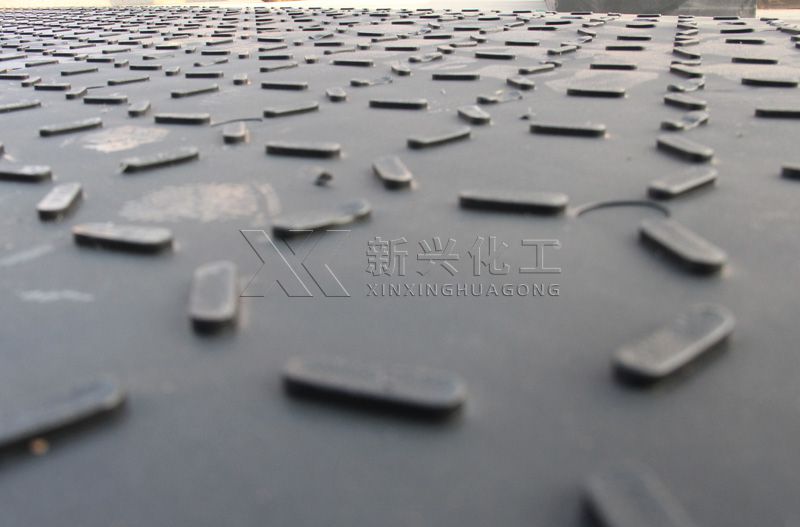
XINXING heavy-duty road mats use textured surface designs to improve tyre traction.
In oilfield conditions, the suitability of the tread pattern should be assessed together with mud accumulation, water, vehicle type and expected braking or turning movements.
Individual panels can be connected to create planned access routes.
Appropriate connections help maintain panel alignment and reduce unwanted separation during vehicle movement.
For demanding oilfield projects, the selected connector design should consider repeated traffic, changing ground conditions and potential movement at the panel joints.
Explore the XINXING Dura Mats range for heavy-duty industrial access applications.
The Songyuan project demonstrates the application of heavy-duty matting on muddy swampland. For comparable projects, the following planning approach is recommended.
Before selecting mats, evaluate the expected ground support.
Important considerations include:
Soil composition and moisture content.
Evidence of existing rutting or settlement.
Surface drainage and standing water.
The presence of buried utilities or unsupported ground.
Seasonal changes in the site's ground conditions.
On very weak soil, geotechnical assessment may be required to determine whether mats alone are sufficient.
Confirm the actual vehicles that will use the route.
Oilfield projects may involve heavy transport trucks, excavators, equipment carriers and drilling support vehicles.
Total vehicle weight should be considered together with axle loads, tyre contact areas, tracked-equipment loading and traffic frequency.
A roadway suitable for occasional truck traffic may not be suitable for concentrated static equipment loads.
The route should accommodate:
Required vehicle travel width.
Entry and exit points.
Turning and passing areas.
Equipment unloading zones.
Access to the wellsite or operational area.
Suitable drainage and traffic management.
Where large vehicles must turn, a wider protected surface may be necessary.
The Songyuan project used 3000 × 2500 × 37 mm panels.
For other projects, panel dimensions and thickness should be reviewed against ground conditions and loading requirements.
XINXING also provides other ground protection mat systems, allowing contractors to consider alternative configurations where appropriate.
Large-format access mats generally require mechanical handling.
For comparable installations, contractors should inspect the proposed route, prepare suitable supporting ground and secure the selected connection system.
A controlled initial vehicle movement can help identify panel shifting, settlement or other problems before regular traffic begins.
Periodic inspections are necessary, particularly after heavy rainfall or repeated equipment movements.
Important: Ground-supported road mats must not be used as structural bridges over unsupported openings, drainage channels or voids without a separately engineered bridging solution.
According to the existing Songyuan project record, XINXING Dura Mats helped establish temporary routes for heavy vehicles and project personnel across challenging muddy ground.
The recorded benefits included:
Improved access for oilfield transport and support equipment.
Reduced vehicle immobilisation and associated disruption.
Less ground disturbance along designated travel routes.
A reusable alternative to constructing some temporary permanent-surface routes.
Improved organisation of traffic and equipment movement.
These are qualitative results reported in the original project description. Quantified cost reductions, project duration improvements and measured soil restoration results were not provided.
Oilfield contractors may consider timber mats, steel plates, gravel routes or composite ground protection mats depending on the project.
| Selection Factor | XINXING Heavy-Duty Polyethylene Mats | Timber Mats | Steel Plates |
|---|---|---|---|
| Moisture exposure | Non-rotting polymer material | Can deteriorate with prolonged exposure | Requires corrosion management |
| Reusability | Reusable subject to condition | Reusable subject to wear and damage | Reusable subject to condition |
| Surface traction | Textured options available | Depends on condition and design | Depends on surface treatment |
| Ground coverage | Connected large-format panels | Depends on mat dimensions | Depends on plate arrangement |
| Installation | Mechanical handling for large panels | Often requires lifting equipment | Requires lifting equipment |
| Key consideration | Panel and subgrade loading | Material condition and connection | Plate movement and supporting ground |
No single material is best for every oilfield project.
Selection should consider ground-bearing conditions, vehicle loading, installation equipment, transportation costs and the expected duration of use.
Connected access mats can provide planned routes for service vehicles, equipment delivery and construction traffic on appropriately prepared ground.
Temporary access routes may be required where pipeline installation equipment must cross farmland, soft soil or environmentally sensitive areas.
Heavy-duty mats can form temporary operating areas for appropriately supported equipment and material handling operations.
Comparable access challenges occur in wind farm construction, power infrastructure projects and remote industrial maintenance work.
Explore XINXING's ground mats for energy projects for additional applications.
Shandong Ningjin Xinxing Chemical Co., Ltd., established in 1989, specialises in engineering plastic manufacturing and temporary ground protection systems.
For oilfield contractors, our capabilities include:
Heavy-duty matting products: Large-format road panels designed for temporary industrial access.
Multiple mat systems: Product options for different ground conditions, vehicle requirements and roadway configurations.
Engineering plastics manufacturing: In-house capabilities including moulding, extrusion, CNC machining, cutting and assembly.
Project-specific recommendations: Assistance in selecting suitable mat dimensions, configurations and connecting systems.
Custom manufacturing options: Available options for selected products include dimensions, thicknesses, surface features and branding.
Our team can review your project requirements and recommend suitable temporary road matting options.
Oilfield temporary road mats create temporary vehicle routes and working surfaces for construction, drilling support and equipment transportation where ground conditions make unprotected access difficult.
Yes, appropriately selected mats can be used in muddy and waterlogged areas. The suitability of the system depends on ground-bearing capacity, equipment loads and site preparation. Extremely weak terrain may require additional support.
Oilfield ground protection mats describe the intended industrial application, while swamp mats generally describe access matting used over muddy, wet or low-bearing-capacity terrain. A matting system may serve both purposes when appropriately designed.
The Songyuan project involved vehicles within the 60–80-ton range. This is project-specific information, not a universal load rating. The vehicle configuration, concentrated loads and supporting ground must be assessed before recommending a mat.
Provide the project location, ground conditions, equipment type, maximum loading, axle or track details, roadway dimensions, expected traffic frequency and required installation period.
Planning an oilfield construction project on muddy or unstable ground?
XINXING can help assess your temporary access requirements and recommend a suitable road matting system based on your equipment, ground conditions and project layout.
Contact XINXING for an Oilfield Access Mat Quotation
Established in 1989,located in Qingdao city of Shandong province, Shandong Ningjin Xinxing Chemical Co.,LTD. is the most professional manufacture of engineering plastics and the only manufacturer who has complete MATS system in China.
Phone
+86 189 0640 6469
Location
Liaohe Road, Ningjin Industrial Zone, Dezhou City, Shandong Province, China.
Copyright © Shandong Ningjin Xinxing Chemical Co., Ltd. All Rights Reserved |
Sitemap
| Powered by